Captured File Output
When agentOutput: file is set, the plugin renders the full terminal buffer to plain text once the run ends and strips out what it recognizes as its own scaffolding or CLI/TUI chrome — the $ <binary> <args> echo line, the CLI's own prompt echo, the turn-completion summary line, the persistent bottom status bar, box-drawing-only lines, and (if the session was killed mid-run) the raw Python KeyboardInterrupt traceback that PTY allocation surfaces on SIGINT.
What's left is written into the note as:
**Agent output** (<button text>, <timestamp>)

<captured content>
Real example — a button with agentOutput: file and append: belowButton, after the session behind it exited:
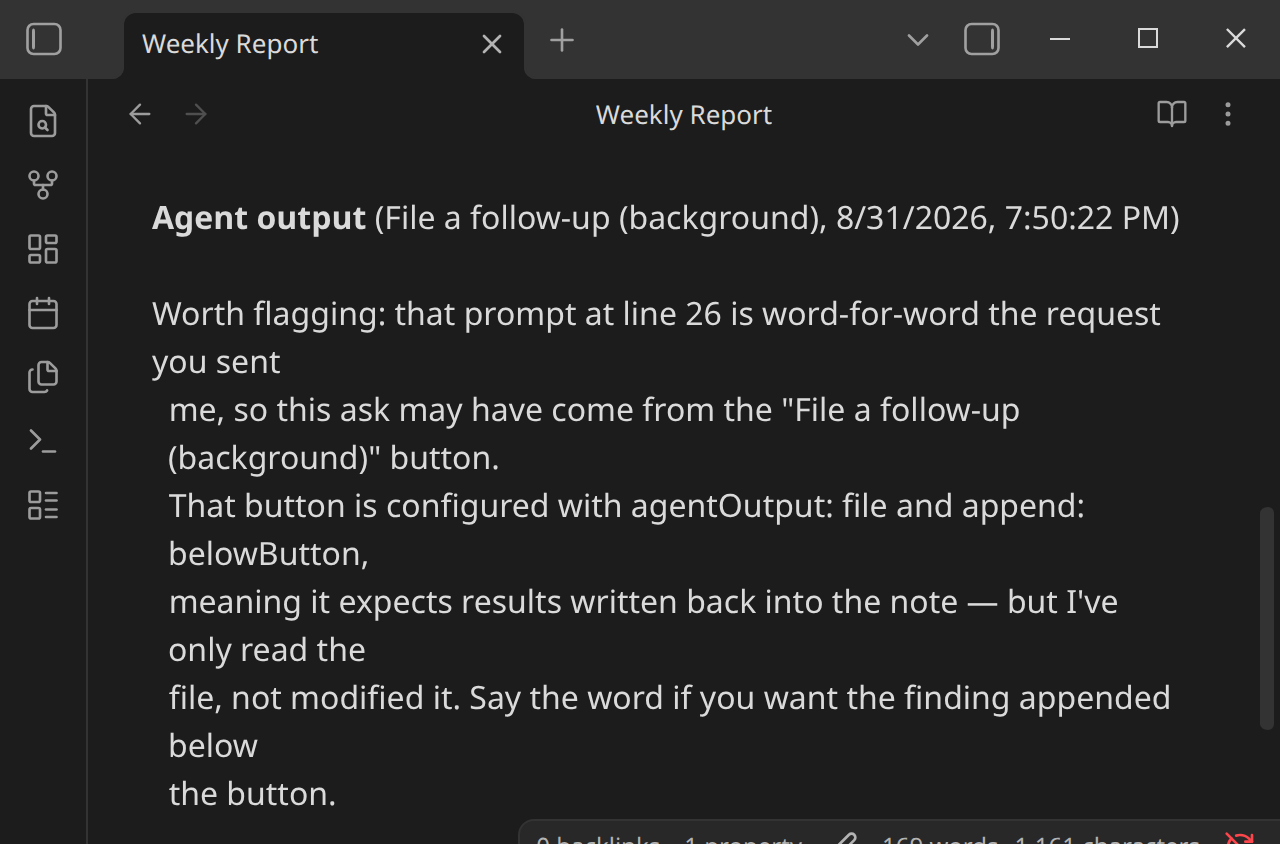
What gets captured
This captures the whole visible session transcript (tool-call summaries included, not just the agent's final reply) rather than attempting to isolate "the assistant's message" specifically — doing real semantic extraction of just the reply would need much deeper, CLI-specific knowledge of each agent's exact output format than is safe to assume here.
It's good enough to drop into a note as a record of the run; it isn't a guarantee of a perfectly clean, chrome-free transcript in every case, especially for CLIs whose output this hasn't been tuned against.
Heuristic, not exact
Both this and completion: responseEnd work by pattern-matching the rendered terminal screen against text Claude Code has actually been observed to print, not by any structured signal from the agent itself. A CLI update that changes its output formatting, or output that doesn't match the patterns this was tuned against, can cause a stray line to survive into the captured output.
When the write actually happens
The write is triggered by the underlying process exiting, not by the agent finishing its reply. Under completion: manual those two things are close together (the session stays in its loading state until you close it, which is also when it exits). Under completion: responseEnd they can be far apart — the spinner clears when the agent finishes replying, but the session (and therefore the eventual file write) doesn't end until the session is later closed some other way.