Markdown Status Marker
A task's current status is encoded directly in its markdown: the character
between the brackets in - [ ].
- Default status is always a plain space —
- [ ]— regardless of what the default status is actually named. - Every other status gets a single character, assigned automatically the
first time you set a task to that status (e.g. "In Progress" →
- [I]). You never choose or manage these characters yourself.
Why a single character, not a readable name
The obvious-looking alternative — something like - [$task=IN PROGRESS] —
was tested live before committing to either approach. The result:
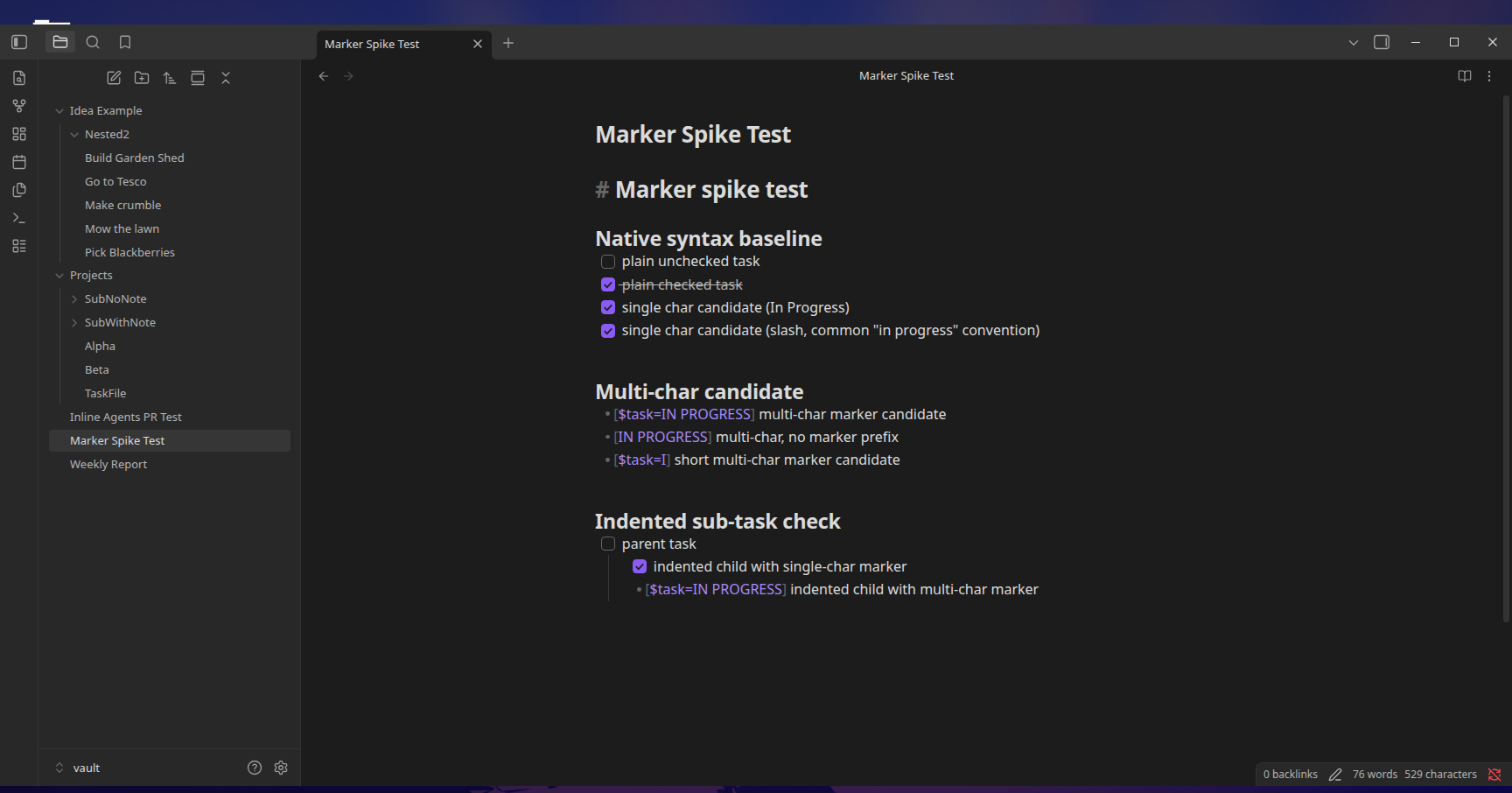
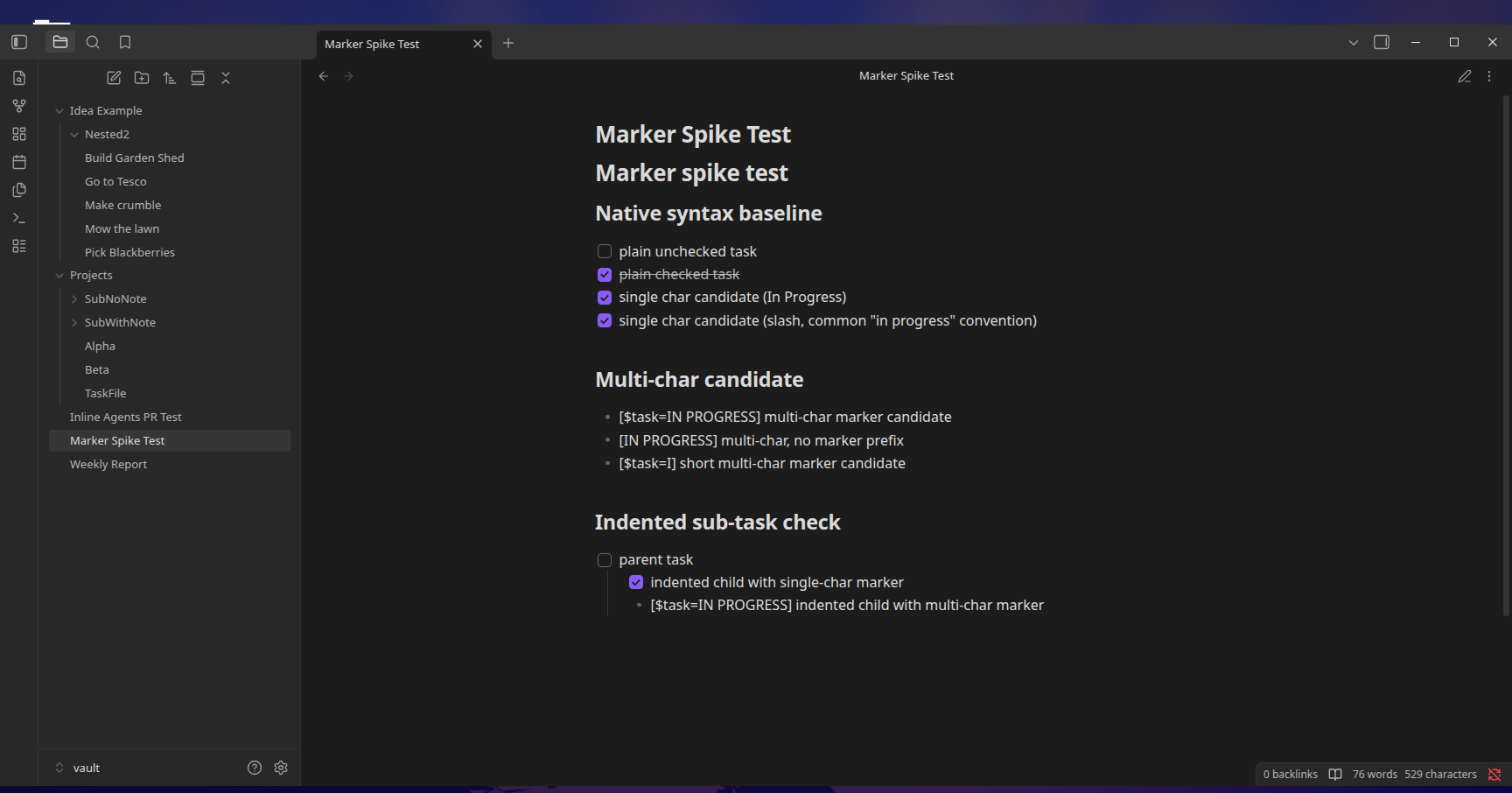
A single character (- [I]) is recognized by Obsidian's own task parser as
a real, interactive task in both views. Multi-character content
(- [$task=IN PROGRESS]) is not recognized as a task at all — it
renders as a plain bullet with the literal bracket text visible. That rules
out the readable-name approach outright: it isn't "a task with unusual
text," it simply isn't a task, so none of Obsidian's own task behavior
(click-to-toggle, task queries, compatibility with other task plugins)
works on those lines.
Stability
The character-to-status mapping is keyed by the status's internal id, not its name — so renaming a status in Status Sets does not reassign or break its character. Reordering statuses, or adding/removing others, doesn't shift it either. It's assigned once and stays put.
The tradeoff: this data doesn't travel with the note
Because the character-to-status mapping lives in this plugin's own local data (not in the note, and not in Status Sets' data), a written marker only means the same thing inside this vault, with this plugin's data intact.
- Renaming a status is safe — existing
- [I]tasks keep meaning whatever statusIis mapped to, because the mapping follows the status's id, not its name. - Copying a note into a different vault, or resetting this plugin's own data, is not — a character written in one vault has no guaranteed meaning in another, since the mapping is assigned independently per vault. Think of it the way you'd think about a tag or wikilink: portable as text, but only meaningful in the vault that defines what it points to.
Matching rule
The marker must be the first thing on the line, aside from leading whitespace/indentation — same as Obsidian's own task syntax.